
Reimagining Education: How Australia Can Unlock $50 Billion in Economic Potential
At Learning Online Group, we recently met Sarah, a successful data analyst at one of Australia’s major banks. Her story resonated deeply with us: despite her six-figure salary and evident talent, she carries $37,000 in education debt for a degree she rarely uses in practice. Her most valuable skills? Self-taught through online resources.
Sarah represents millions of Australians navigating an education landscape that’s struggling to keep pace with our rapidly evolving economy. Research from the Productivity Commission suggests Australia could unlock at least $50 billion annually in productivity by better aligning education with industry needs and making quality training more accessible.
As an online education provider, we see first hand how talented Australians are seeking alternatives—flexible, practical, and affordable pathways to career success. It’s time to explore how we can collectively transform education to better serve both learners and our economy.

Breaking Down Geographic Barriers
Nearly 7 million Australians live in rural and remote areas, facing significant challenges accessing quality education. Consider the talented individuals in places like Broken Hill or Arnhem Land, whose potential remains untapped simply due to distance from traditional institutions.
The economic implications are substantial. If even 10% of these geographically isolated Australians could access quality education and develop high-value skills, the productivity gains could reach $84 billion annually based on average productivity increases of $120,000 per skilled worker. Countries like Estonia have demonstrated what’s possible, with 99% of government services, including education, delivered online to all citizens regardless of location.
Even within our cities, long commutes to educational institutions consume valuable time—sometimes up to 20 hours per week—that could be spent learning or earning. The average Sydney commute is 71 minutes daily, and education commutes often exceed this. Digital education eliminates these barriers, making quality training accessible to everyone, everywhere.
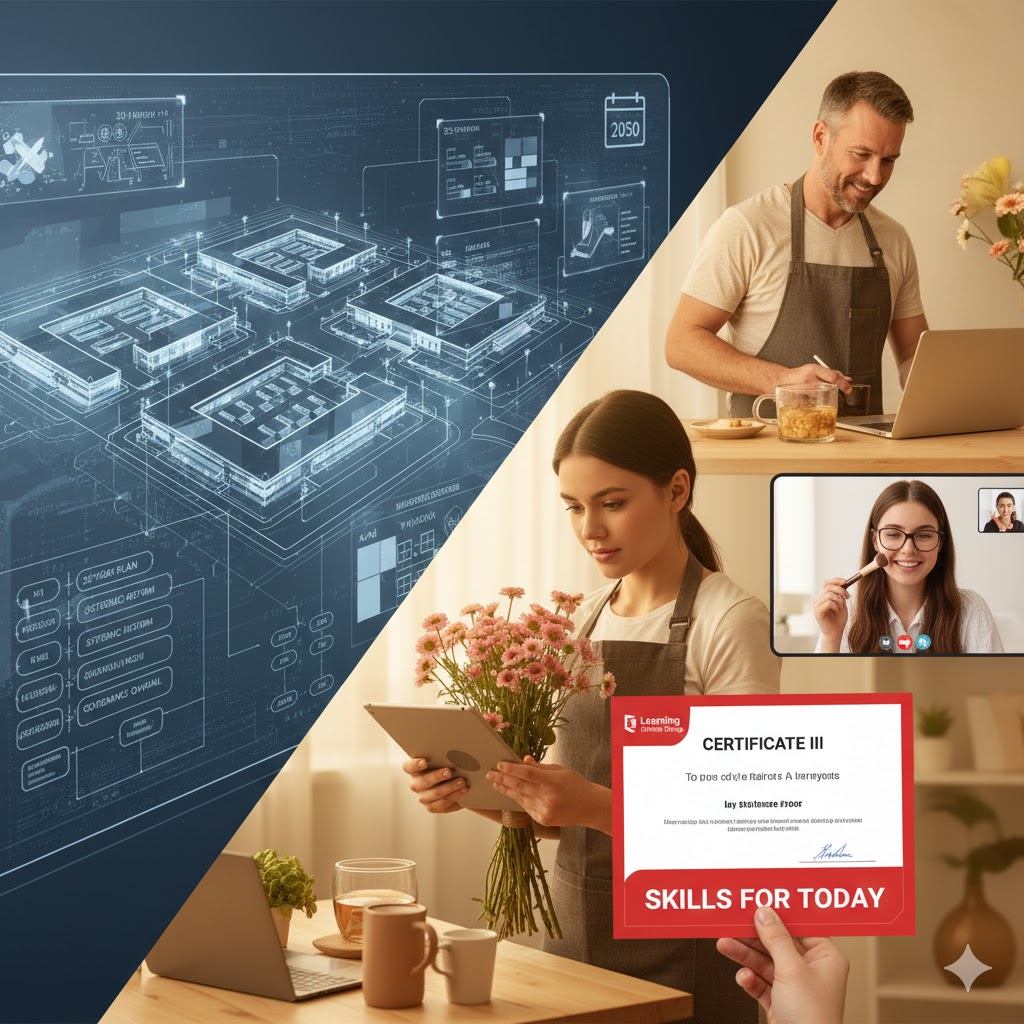
At Learning Online Group, we witness this transformation daily. Indigenous artists accessing photography training from remote communities. Military veterans in regional areas pursuing business education. Single parents studying beauty therapy without leaving their children. These aren’t exceptions—they’re examples of the millions of Australians who benefit when education becomes truly accessible.

Responding to Industry Needs with Agility
The pace of change in today’s economy presents both challenges and opportunities. According to the World Economic Forum, technical skills now have a half-life of just 2.5 years, while traditional education pathways often take 3-4 years to complete. This timing mismatch creates gaps that innovative education models can fill.
Consider recent technological shifts: ChatGPT reached 100 million users in just 2 months, transforming programming practices overnight. TikTok created a $100 billion creator economy faster than traditional institutions could develop relevant courses. The drone industry is projected to reach $43 billion by 2025, evolving from hobby to critical infrastructure in just 36 months.
Online education providers can respond to these changes in weeks, not years. At Learning Online Group, we launched AI training courses within 8 weeks of identifying industry demand. Our beauty therapy programs incorporate techniques that emerged just months ago. Our photography courses evolve with each new camera technology release.
This agility benefits everyone. Students gain immediately applicable skills. Employers report 73% struggle to find workers with needed skills. The economy captures productivity gains without delay. One of our recent graduates shared: “I earned back my course fees in my first three months using what I learned.” This rapid return on investment demonstrates education’s potential when it aligns with real-world needs.

Creating Sustainable Learning Pathways
Traditional education models often create significant financial burdens, with average HELP debts reaching $26,000. This debt impacts not just individual finances but broader economic participation, affecting home ownership rates among young Australians, entrepreneurship, and consumer spending.
Alternative models offer more sustainable approaches:
Continuous Micro-Learning: Short, focused courses that deliver specific skills. Learn, apply, earn, then build on that foundation. Research from Deloitte shows micro-learning increases knowledge retention by 80%.
Pay-Per-Skill Models: Instead of large upfront investments, learners can acquire skills as needed. Need Excel proficiency? Two weeks, $200. Want to add drone photography? Three weeks, $500. Build qualifications progressively as finances allow.
Portfolio-Based Recognition: LinkedIn’s 2023 Workplace Learning Report found 89% of L&D professionals agree that building employee skills helps navigate the evolving future of work through practical demonstration rather than theoretical testing.

Recognizing Existing Skills and Experience
Australia has tremendous untapped talent. Over 1 million skilled migrants are underemployed, often working in jobs below their qualification level. Self-taught programmers with successful apps but no formal credentials. Experienced practitioners whose knowledge isn’t formally recognized.
Progressive recognition frameworks can unlock this potential. At Learning Online Group, we emphasize demonstration of skills over documentation of attendance. Can you perform the task? Show us through your portfolio, project, or practical demonstration. This approach has helped our graduates secure employment faster and perform better in their roles.
Industry increasingly values this practical approach. Major employers tell us they need problem-solvers, not just certificate holders. Google, Apple, and IBM have removed degree requirements for many positions, focusing instead on demonstrated skills.
Building Tomorrow’s Workforce Today
The global context underscores the importance of education reform. India’s workforce will grow by 33 million skilled workers by 2028. China produces 4.7 million STEM graduates annually. Singapore invests 20% of its budget in education and skills development.
Australia’s response must be swift and strategic. Climate change will require 1 million workers to transition to new roles. An ageing population requires 50,000 new aged care workers. Automation threatens 2.7 million Australian jobs while creating new opportunities. These challenges require immediate action, not lengthy deliberation.
Online education is already delivering results. Last month alone, Learning Online Group trained:
- Over 500 beauty therapists in cutting-edge techniques
- 200 wildlife carers in trauma response
- Nearly 1,000 photographers in AI-enhanced creativity
Total time: weeks, not years. Total cost: thousands, not tens of thousands. Total impact: immediate and measurable.

A Collaborative Path Forward
The transformation of education isn’t about replacing traditional institutions—it’s about expanding options and creating complementary pathways. The Bradley Review emphasized the need for diverse approaches to serve diverse needs:
- Universities for deep research and theoretical foundations
- Vocational education for hands-on trade skills
- Online providers for rapid upskilling and reskilling
- Industry partnerships for specialized training
- Micro-credentials for continuous professional development
At Learning Online Group, we’re committed to playing our part in this ecosystem. We’re building education that’s fast, affordable, accessible, and relevant. We’re proving daily that Australians can succeed with practical skills and focused training.
The Opportunity Ahead
The $50 billion productivity opportunity isn’t just a number—it represents real potential for millions of Australians. It’s the regional entrepreneur who can finally access business training. The working parent who can upskill without sacrificing family time. The career changer who can transition without crippling debt.
The Australian Government’s Job and Skills Summit identified education reform as critical for economic growth. The Universities Accord recognizes the need for more flexible, accessible pathways to education.
We invite all stakeholders—educators, employers, policymakers, and learners—to join us in reimagining education. Together, we can build a system that serves everyone, everywhere, at every stage of their career.
Because when education becomes truly accessible, affordable, and relevant, everyone wins. Individuals achieve their potential. Businesses find the talent they need. And Australia secures its position in the global knowledge economy.
The future of education is already here. Now it’s time to make it available to all Australians.
Learning Online Group supports over 15,000 students globally since 2019, providing job-ready skills as a modern alternative to traditional education. Explore our specialized brands including: Australian Beauty School, Omnia Tattoo Academy, NZ Beauty School, Australian Photography School and My Learning Online.